GCBC Week 7: “Of Regrets and Resolutions” By President Dieter F. Uchtdorf

Happy Thanksgiving week, everyone. I know it will be a busy one, but I think this talk might help us keep focused on what matters most.  It’s now week 7 of general conference book club, and we’ll be studying President Uchtdorf’s message– the last talk from the Saturday A.M. session:

Of Regrets and Resolutions

By President Dieter F. Uchtdorf


President Uchtdorf talked about some of the things that people seem to reflect on the most when they are facing death. He pointed out three major common regrets:

  1. I Wish I Had Spent More Time with the People I Love
  2. I Wish I Had Lived Up to My Potential
  3. I Wish I Had Let Myself Be Happier

Which one of these stood out to you? Number 3 was a great reminder to me because I tend to get frustrated with my children when days seem full of setbacks and pushback, and I have a hard time letting it go and moving forward with any measure of cheer. This was a good reminder to me to spend more time choosing to be happy even when things, or even whole days, go wrong.

Because we make mistakes, most days will include something we regret doing or saying. Even though it wasn’t a major focus of the talk, I felt the importance of apologizing, repenting, and carrying on with minimal regret so that we’re not stockpiling regrets until the end of life.

What did you like and learn from this talk? Please share in the comments below some of your insights.

(A reminder to those of you who are new to General Conference Book Club: You’re welcome to return to this post any time this week and leave your comment and thoughts in the comment section below. You may also want to see what others are saying about the talk and engage in a conversation for mutual understanding and encouragement. A new talk will be posted each Sunday and will be studied and discussed throughout the week.)

Faith, Prayer, Repentance, Forgiveness: The Power of Apology

There’s that one song on the radio that says over and over, “It’s too late to apologize, it’s too late.” That song bugs me, because if you’re still alive, it’s not too late. I mean (Pretend I’m talking out loud to my radio in the car. It’s been known to happen.), you might be too proud to apologize, or too scared to apologize, or it might seem too hard to apologize, but I guess that doesn’t make for good lyrics. Too late? Lame excuse.

The Family Proclamation lists the ingredients of successful marriages and families. If I were to rewrite one sentence from the Proclamation in the form of a recipe, I think it would look something like this:
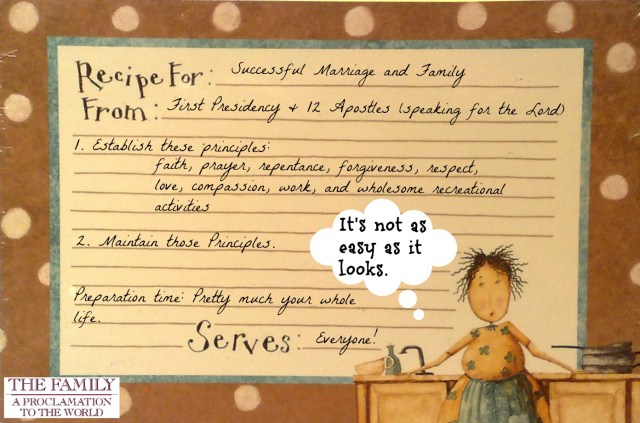

It seems simple enough, but it is hard work (which, coincidentally, happens to be one of the ingredients). And since it is challenging, we mess up. Often. That’s why I think that the two ingredients that will have to be added over and over to the recipe are repentance and forgiveness. Consider the following words of wisdom:

“To be guileless is to have a childlike innocence, to be slow to take offense and quick to forgive. These qualities are first learned in the home and family and can be practiced in all our relationships. To be guileless is to look for our own fault first. When accused, we should ask as the Savior’s Apostles did, “Lord, is it I?”. If we listen to the answer given by the Spirit, we can, if needed, make corrections, apologize, seek forgiveness, and do better.” —Elder Robert D. Hales

“To any[one] within the sound of my voice who has trouble controlling his tongue, may I suggest that you plead with the Lord for the strength to overcome your weakness, that you apologize to those you have offended, and that you marshal within yourselves the power to discipline your tongue.” —President Gordon B. Hinckley

“The sweet peace the gospel brings never comes at all when we justify our misconduct or blame others for our unhappiness. But there is a way out. … Face up, quit, get out, confess, apologize, admit the harm we have done…” —Elder F. Burton Howard

“On a visit to see my Uncle Ray last year, … Hanging on the kitchen wall was a framed expression which my aunt had embroidered. It carried a world of practical application: ‘Choose your love; love your choice.’ Very often this will take compromise, forgiveness, perhaps apology. We must ever be committed to the success of our marriage.” —President Thomas S. Monson

“Every marriage is subject to occasional stormy weather. But with patience, mutual respect, and a spirit of forbearance, we can weather these storms. Where mistakes have been made, there can be apology, repentance, and forgiveness. But there must be willingness to do so on the part of both parties.” —President Gordon B. Hinckley

“You have felt [your Heavenly Father’s approval] in your family when you asked the pardon of your spouse or forgave a child for some mistake or disobedience. These moments will come more often as you try to do the things you know Jesus would do. Because of His Atonement for you, your childlike obedience will bring a feeling of love of the Savior for you and your love for Him.” —President Henry B. Eyring

There’s a reason I chose to write about the importance of repentance and forgiveness in family relationships. The reason is me. I make mistakes all the time. Just yesterday, I lost my patience with both of my sons for performing below their potential at school. What I considered tough love was probably, in part, actually a little unkind. This morning, I lost my temper when my daughter refused to eat breakfast and responded to me with defiance. Here’s the thing: I am the parent, but I am still the learner, too. So when the Spirit pricks at my heart and says, “You could have handled that better,” then I need to swallow my pride and apologize. When I dropped off Natalie at school today, before I let her hop out of the van, I pulled her up onto my lap, looked into her pretty blue eyes, and said, “Does Mommy need to apologize?” She nodded her head. I told her I was sorry and that I had acted wrongly. I asked her forgiveness. I gave her a hug. And as I drove away, I promised Heavenly Father that I would try (again and again) to do better.

One of my favorite things about my husband is that he usually says sorry first–even when the fault is as much or more mine than his. It is an immediate diffuser of coldness and distance. When someone sincerely says “I’m sorry,” we can breathe easier as we work through our disagreements. And because we hope our Heavenly Father will forgive us all the way when we make dumb mistakes, we need to be willing to offer that same kind of forgiveness to others, especially those with whom we have covenant relationships.  I’ve always loved this powerful analogy by Elder Holland:

Let people repent. Let people grow. Believe that people can change and improve. Is that faith? Yes! Is that hope? Yes! Is it charity? Yes! Above all, it is charity, the pure love of Christ. If something is buried in the past, leave it buried. Don’t keep going back with your little sand pail and beach shovel to dig it up, wave it around, and then throw it at someone, saying, ‘Hey! Do you remember this?’ Splat!

Well, guess what? That is probably going to result in some ugly morsel being dug up out of your landfill with the reply, ‘Yeah, I remember it. Do you remember this?’ Splat.

And soon enough everyone comes out of that exchange dirty and muddy and unhappy and hurt, when what God, our Father in Heaven, pleads for is cleanliness and kindness and happiness and healing. Such dwelling on past lives, including past mistakes, is just not right! It is not the gospel of Jesus Christ.”

So when you find that your relationship with your spouse or your child is strained (as it will often be), put down your shovel and pail, put down your pride, and say “I am sorry.” When spoken with a humble heart, and then followed by an “increase of love” or any of the other ingredients, your marriage and family recipe is one step closer to successful. The song got it wrong: It’s never too late to apologize.

♦♦♦♦♦♦♦♦♦♦♦♦♦♦♦♦♦♦♦♦♦♦♦♦♦♦♦

Click here to read a complete version of The Family: A Proclamation to the World. The celebration will continue through Sept. 30.

Remember that during the world-wide-web Family Proclamation Celebration, you can read more posts every day at We Talk of Christ, at Chocolate on My Cranium, and at Middle-Aged Mormon Man.

Mom Shame: Whom the Lord loveth, He maketh cry like a baby.

I paraphrased that scripture in the title a little bit.  It really says “For whom the Lord loveth he chasteneth,” but I was just trying to make it more accurate as it relates to me.

(Deep breath.)

I’ve been drafting this post in my head for five days, and it’s still going to sting a little.  In fact, as soon as “the incident” happened, I knew I was going to have to blog about it, but that I would have to wait until I had recovered my dignity.  I don’t know why I feel so compelled to tell this story, but my best guess is that it has something to do with confessing and moving on.

I’ve been busy. There’s the regular busy:  the meals, laundry, carpool, church responsibilities, volunteering at kids’ schools, homework and chore supervision, etc.  On top of that, I have several writing projects going on, many of them with deadlines (even if they’re self-imposed). I’ve also had some lesson and teaching preparations happening on the side. I’ve been doing some behind-the-scenes research and really-small-scale activism about some social issues that have captured my attention and that I feel strongly about. It seems like I’ve had a really long ever-growing list of emails to reply to and appointments to make and stuff that just keeps taking a few minutes here and a few minutes there.  Other tasks and details added to my juggling efforts, and I started to feel a little out of balance.  You know, the nagging feeling that maybe I needed to pause and refocus, but I was too busy to do that, so I just left the thought hanging and kept on going.

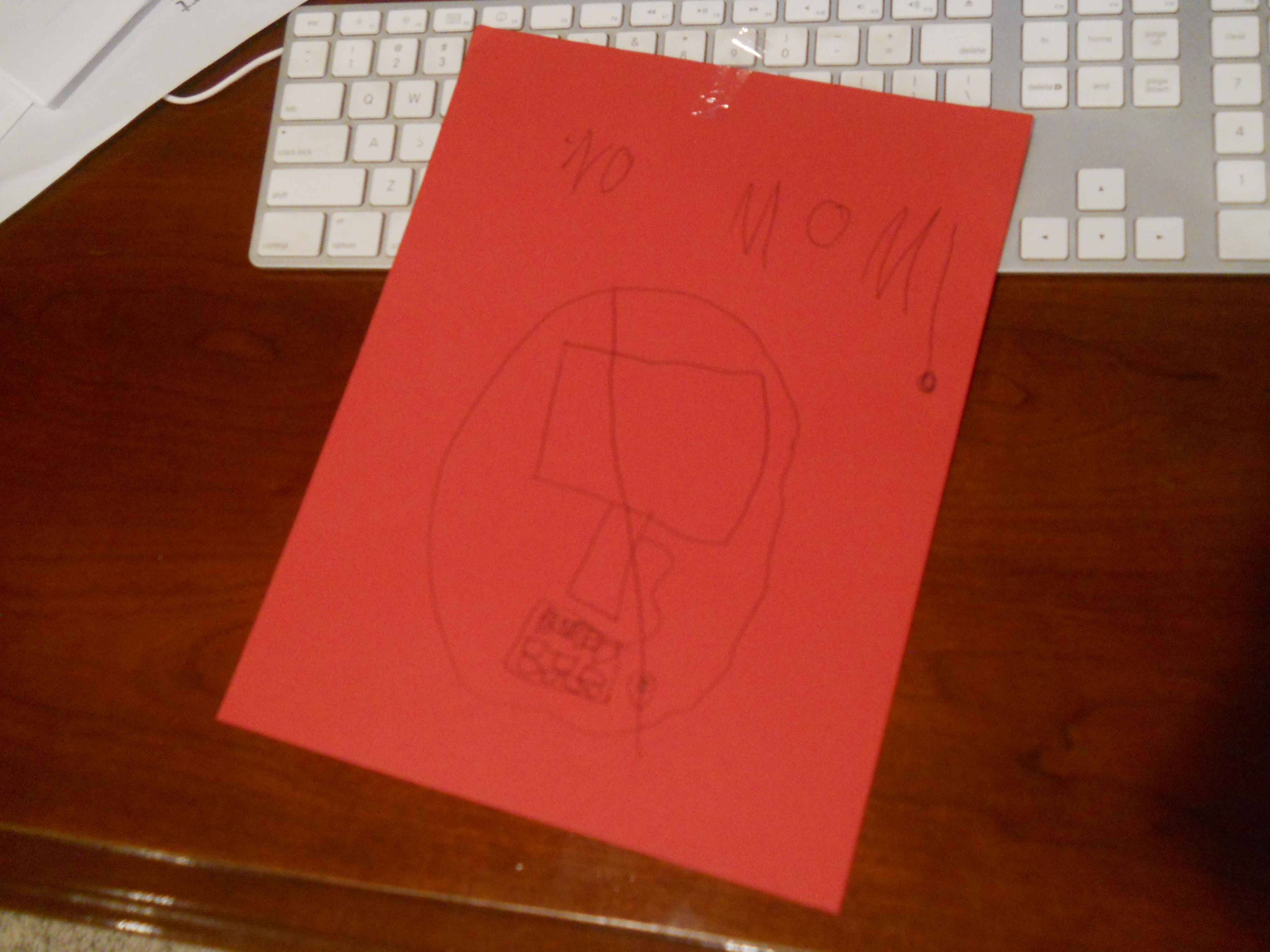
Fast forward to Friday.  I was hosting a girls’ night party at my house that night, so I was engaged in must-get-the-house-clean-and-do-party-prep mode.  I got sucked into some emails and other online “business” in the morning that I kept going back to and checking on in between chores.  The boys were at school and Natalie was working on her own chore chart and then I turned on a show for her.  The phone rang and I talked to my good friend for a while.  Toward the end of our conversation, I told her I would email her a link about something we were discussing, and I headed toward the computer to log in and pull it up on the screen.  When I walked over to my desk, I saw this note taped to my keyboard.  It knocked the air out of me.

It felt like a kick in the stomach. I stumbled through a quick goodbye to my friend, hung up the phone, and carried the paper into the family room.  Natalie was sitting on the couch.  She saw the paper, and her eyes were wide waiting for my reaction.

I started to cry.

“I’m sorry, Natalie.  Do you feel like I think the computer is more important than you are?”  She nodded yes.

“Have I been a bad mom?”  Yes again.

I cried more and said I was sorry more.  She looked a little worried, but she hugged me, and she mostly seemed relieved for having voiced her grievance and been understood.  I, on the other hand, was mortified.  Here I was writing a book about motherhood, blogging about motherhood, trying to find ways to fight pornography and protect my children, and frankly, forgetting to be a good mother.  I felt it deep.  You can talk it away and rationalize, but I know it was a necessary, personal wake-up call.  It was a guilty flame that burned out a little hole inside of me, and God was giving me a chance to fill it back up again with the right stuff.

I talked to a friend.  I talked to my mom.  And when I thought I could tell the story without crying, I told Matt.  I was wrong.  We all came to the same conclusion.  I was doing good things.  I really was, but I neglected the most important things.  It was a classic case of good, better, best, and I failed.  It’s not like I had abandoned my children and all household responsibilities, but I could have done better.  I should have done better.  I like to think that God heard my silent heart-prayers about feeling out of balance and not quite knowing where to fix it, and then He sent me a lightening bolt answer.  It wasn’t a fun answer.  It was humiliating.  But it was the right answer.  It was just hard.

Natalie and I have talked about it more, and we’ve come up with a system that allows me to work on some projects, but still gives her the time and attention she needs from me.  It will take a little time for me to change some habits, remind myself often what matters most, and get things balanced again.  It’s totally worth it.  Maybe even the shame part.

“For where your treasure is, there will your heart be also.” –Luke 12:34

—-

A few post-scripts:

1.  The girls’ night was fun!  Natalie joined in and loved it.
2.  Next weekend is the Story @ Home conference in Salt Lake, where my friend Jana is teaching this workshop: “Striking a Balance with Real life and Online: It’s unacceptable to put our families in crisis or fail and give up on our dreams, both can work.  Come learn five essential principles for following your dreams and striking a balance while keeping God and family first.”  Coincidence?  I think not.  Come join us.
3.  The book I contributed to is still at its special pre-sale price.  Here’s a link to know more and buy a copy or two.  🙂

GCBC Week 16: “As Many as I Love, I Rebuke and Chasten” by Elder D. Todd Christofferson

First of all, thanks to all of you who checked in to the roll call last week.  I’m glad to know there’s still a little army marching along.  🙂

I really, really like this talk by Elder Christofferson.  Maybe it’s because the Lord teaches me often through chastening. The “naggings” of the Holy Ghost have frequently been the means by which I finally get my act together and do what I know I should be doing.  And I’m grateful for that.

“As Many as I Love, I Rebuke and Chasten” by Elder D. Todd Christofferson

Some of my favorite quotes in this talk were:

Divine chastening has at least three purposes: (1) to persuade us to repent, (2) to refine and sanctify us, and (3) at times to redirect our course in life to what God knows is a better path.

If we sincerely desire and strive to measure up to the high expectations of our Heavenly Father, He will ensure that we receive all the help we need, whether it be comforting, strengthening, or chastening.

What parts of his message stood out most to you? How do you think we can apply these lessons?  Share your thoughts in the comments below.  If this is your first visit to GCBC, visit here to learn more about it, and join the fun.

GCBC Week 15: Cleansing the Inner Vessel

Thank you to those of you who have been diligent with GCBC even when I have not been. The past few weeks have brought on several unexpected circumstances that have demanded large quantities of my time, so thank you for being patient with my very intermittent and lame posting.  🙂

This week’s talk is President Packer’s talk about the power of repentance and of the priesthood to heal especially some of the more common ills and temptations of today’s society.

“Nowhere are the generosity and the kindness and mercy of God more manifest than in repentance.”

“Cleansing the Inner Vessel”

President Boyd K. Packer
President of the Quorum of the Twelve Apostles

I previously wrote a little rant where I shared some of my feelings following much of the “controversy” that was arisen from this talk.  I want to make clear that this forum has never, will never and is not now a place to criticize or question the Lord’s anointed.  While questions may obviously arise, I feel that they should always be taken to the Lord, made an object of prayer and study, and not expressed as criticism.

Having said that, I invite you to look at this talk as directed at your very own life and how it can apply to you personally.  What are the stand-out messages, warnings, counsel, and encouragement that you get out of it?

If this is your first time to General Conference Book Club, welcome.  Here is a link that explains how you can join us.