A joy report.

After all those serious posts the last few days about how January bites and the world is falling apart, I realized that those of you who just started visiting recently probably think I’m kind of a downer.  I’m lucky enough to know that most of the rest of you who have been around for a while know me a little better and can just roll your eyes and think:  She’ll be over it in a couple days.

So here’s a report about some things that are making me happy lately.

Last weekend, we went to St. George.  Matt took the kids and hung out with his dad, and I stayed by myself all day to write.  I’ve been working on a book for a while, but I really needed some alone time to catch up.  It was wonderful.  I learned so much and wrote a lot, and honestly felt the Spirit a lot.  It was a great dose of invigoration.

I’m sure a small part of my writing success was due to having these on hand:

Next: I like to give parties.  I am not a really good party giver because I never take the time to scan Pinterest or Google for ideas to make my parties all they could be.  I don’t really decorate or craft or do much of anything for parties because I kind of feel like great company is what makes a good party (plus I’m lazy).  I just like to create an excuse for people to get together and then I like to enjoy those people.  So for the last two years, I’ve planned some kind of girls’ night out for February (probably to recover from January).  These February girls’ nights seem to have a recurring theme.  Last year, a group of us went to see the play Persuasion at BYU. And eat of course.  The year before, I did something I loved in Minnesota called a J.A.M. party:  A Jane Austen Marathon.  It was so fun, and since I obviously don’t get sick of Jane Austen, I’m going to do it again this year.  So if you live near Happy Valley in Utah, or are willing to drive that direction, you’re officially invited to J.A.M. Party 2012.  Here is a geographical hint.  (I’m so cryptic.)

The party is not actually in this building, because, well, that would just be silly, but it gives you an approximate location.  It will be February 24th.  We will watch Persuasion, Sense & Sensibility, and Pride & Prejudice, all in a glorious row.  And eat of course.  Email me if you want more details (address is on the sidebar in the “Nice to meet you” paragraph).  Once I have used my superpowers to determine you are not a creep, I’ll give them to you (the details, not my actual superpowers).  So anyway, yay! I’m excited about that.

Moving on.  I have been loving the Ensign and general conference, but duh.  You already knew that about me.

You may have noticed that in the aforementioned overly-serious posts, I used the word “hard” a lot.  Today I  drove Natalie to gymnastics.  She was recently invited to be in a higher-level class which is, obviously, more difficult.  She’s only been a few times, and she has a little anxiety about it.  It’s not as easy and carefree as her little preschool gymnastics were, so she tried to convince me that she doesn’t like it.  The thing is, I know she does like it.  She does cartwheels, roundoffs, handsprings, etc. around my house endlessly.  She loves it when people watch her and tell her how great she is.  She’s just nervous about the new class.  So I started reassuring her in all the ways I knew how, trying to build her confidence.  I said, “Here’s one thing I know about you:  You can do hard things, and you are smart and strong.”  She held back a grin and stared out the window.  When we arrived at the gym, her nerves returned and she didn’t want to go in.  I helped her change into her leotard.  “No peeking,” I said, and then I grabbed a pen and took her hands.
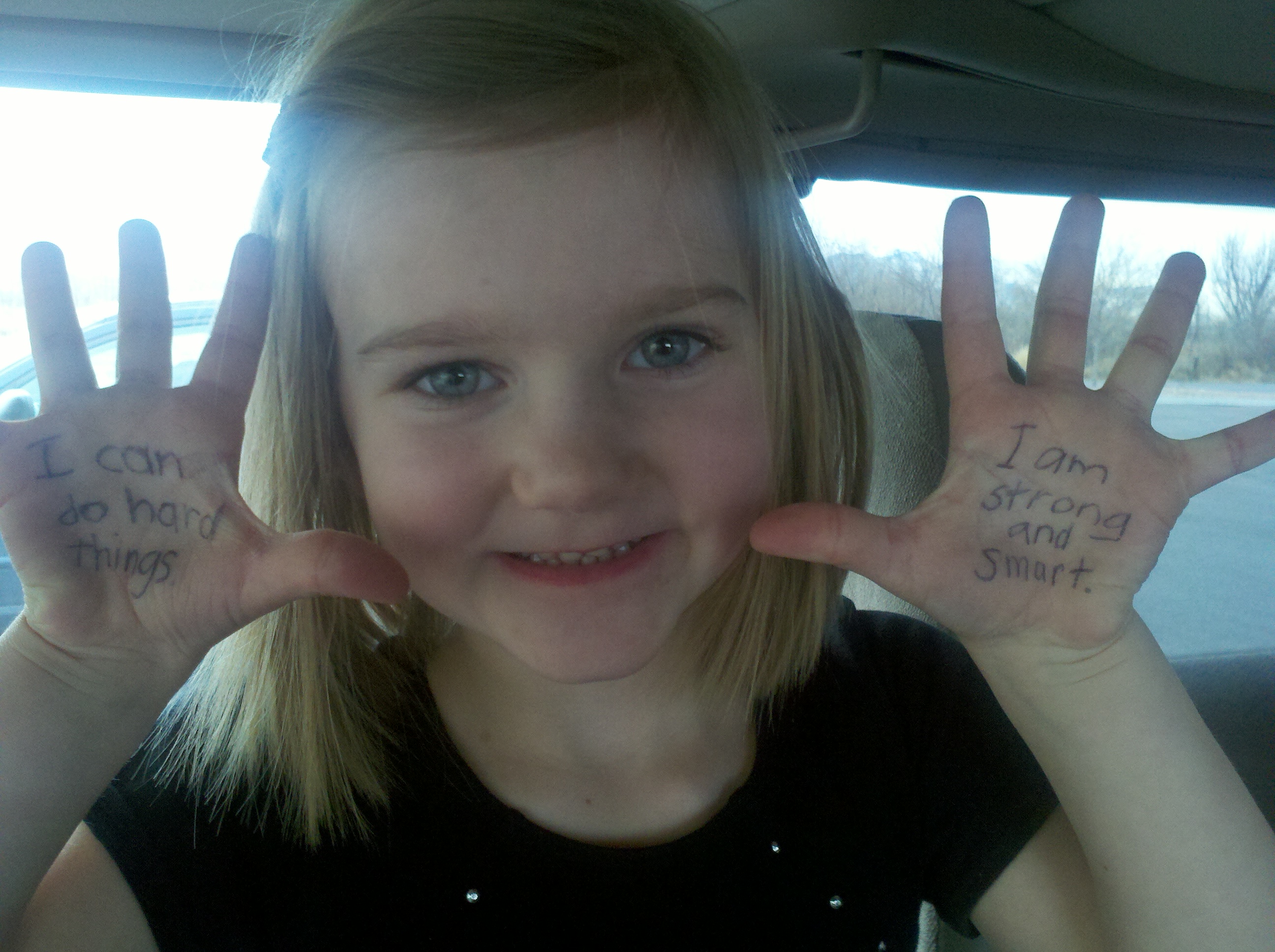
While we walked into the gym, she kept looking at her hands and giggling.  I told her to look at her hands every time she felt nervous in her class.

Then I started thinking some more on the way home about the stuff I already wrote about.  And I started giving myself my own lecture.  “I can do hard things, too.”  I remembered that Sister Dalton talked about that once, so I looked it up and found it.

Last general conference, I was called by President Monson to be the new Young Women general president. As I stood in the presence of a prophet of God and was given this sacred trust, I pledged that I would serve with all my heart, might, mind, and strength. Prior to this calling, I had a small plate inscribed with a motto that read, “I can do hard things.” That little plate bearing that simple motto gave me courage. But now if I could change that motto, it would read: “In the strength of the Lord, I can do all things.” 

And then I did something that will amaze you.  I made a printable. Or quote, or whatever.  I don’t know the real terms.  I only have the skill to make things out of Microsoft Word and Google Images, so if any of you have some old version of Photoshop you want to give away for Valentines Day, you know who to call.  Anyway, here it is:
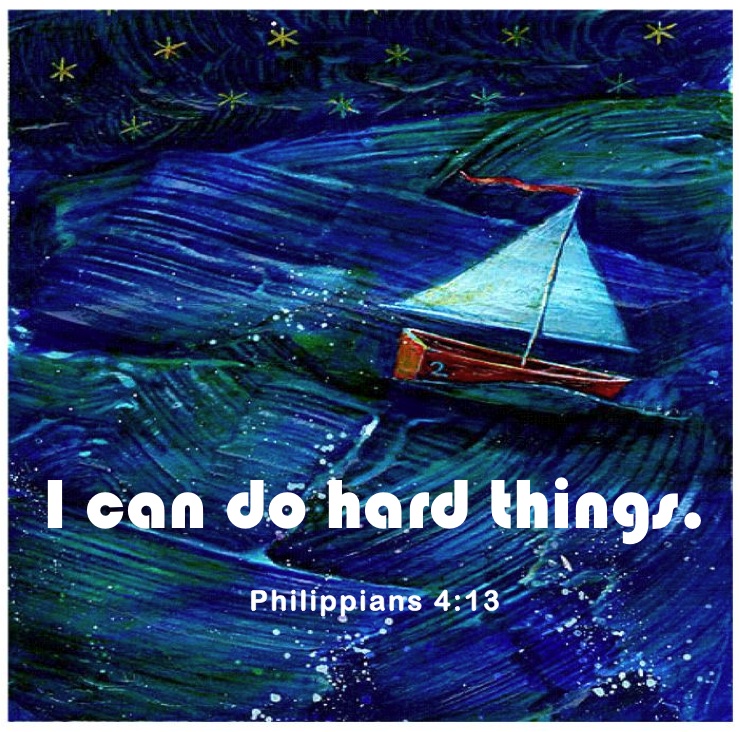
(I was thinking about that one quote about not crashing your heart on the rocks of grief.)  So now that quote is making me happy, too.

Last item on the joy report:  I’m going to the temple tonight.  All those people I’m worried about are going right on the prayer roll, and Heavenly Father is going to take care of them.

How about you?  What’s making you happy these days?

Coping and Mothering: Overcoming Discouragement

I went to lunch several months ago with some friends.  During a side conversation, one friend said to me, “That’s the worst part about growing up: learning about everyone’s problems.”  I don’t even really remember the context of our discussion, but her comment has stuck with me.  It’s so true.  As a child, we have a very limited view of the world at large, and most of my memories are happy and carefree.  As we grow older and our view of the world around us expands, we are exposed to more and more pain, suffering, and sadness– sometimes our own, but often in the lives of others too.

Over the last several weeks, Matt and I have been struggling with watching people we know and love go through some really hard things.  Not just one or two friends, but several.  There are marriage troubles, there are health issues, there are fears and anxieties.  It has made us heavy-hearted, and frankly, a little discouraged.  We want to fix things and we just can’t.  We want to help, but feel so helpless.  It kind of makes us want to hide from the whole scary world so we don’t fall into the same pits, but where and how?  We start to wonder if everyone else on the planet has some deep, dark secret pain going on, and maybe we’re the only people who have “normal” trials, like bad days at work or budget woes or struggling to keep up with the demands of busy lives.  (Does anyone else feel like that sometimes?)  It of course puts your own trials into startling perspective, but it leaves you feeling a vicarious pain for what everyone else seems to be going through.  And even though your own life is relatively “easy,” it’s not easy to watch the pain that’s happening around you.  It hurts.

I’ve noticed it’s difficult to brush those feelings aside and deal with the matters at hand, like helping children with homework or finding socks or making dinner.  They have no idea about the hard things going on in the lives of friends and family.  You certainly don’t want to make it their burden either, but it’s hard to put on a happy face and go on like nothing’s wrong.  This morning, after I got the boys off to school, I tried to get Natalie occupied with her own activities so that I could just crawl back into bed and think.  Rest.  Decompress.  She kept coming into my room every 5 minutes to ask for help with milk or TV buttons or questions.  I was losing patience quickly.  It’s really hard to heal and mother at the same time.  I wasn’t very kind.

I don’t have any real answers to this.  I’m still working through it, but I wanted to share some of the things I’ve been thinking about and learning about in the meantime.  Yesterday, I had a rare opportunity to be in the car by myself in between some carpooling drop-offs and pick-ups.  I wanted something to listen to in the car that would help me focus my thoughts, and I remembered that I had an old general conference CD set somewhere.  I scanned the bookshelf in the office, found it, and grabbed it.  I really wish I had some kind of system in my car where I could just hook up my iPod and listen to whatever I want whenever I want, but I don’t.  And it seems really dumb to invest in that kind of stereo equipment when my van is pushing 160K miles.  Anyway, I had general conference CDs from 1998, and I popped them in and listened while I drove.

This morning I had to go to the dentist, and the CD was still in when I turned on the car.  I heard the end of one talk that was nice.  They had all been nice, but nothing had jumped out at me so far.  Then I heard this talk:  “Overcoming Discouragement” by Elder Val R. Christensen.  Here are some of the things that I learned:

Many of us face significant challenges. Even the great prophet Enoch experienced sadness when he viewed the wickedness of the world: “And as Enoch saw this, he had bitterness of soul, and wept over his brethren, and said unto the heavens: I will refuse to be comforted; but the Lord said unto Enoch: Lift up your heart, and be glad; and look” (Moses 7:44).

There are at least three steps to take when striving to overcome discouragement:

  1. You can work on changing your attitude toward the problem. Even though you can’t change the circumstances in which you work or live, you can always change your attitude.
  2. You can receive help from those who are close to you—your family, friends, and ward members, those who love you the most.
  3. You can develop a more powerful and complete trust in the Lord Jesus Christ.

Even before he started explaining his three points, I knew that there was truth in them.  I felt the Spirit– enlightenment and hope.

By looking at a problem in a different way, it may be possible to reduce discouragement. I have been impressed with the pioneer story told about Zina Young. After experiencing the death of parents, crop failure, and sickness, she was encouraged with a spiritual experience that changed her attitude. While attempting to seek divine help, she heard her mother’s voice: “Zina, any sailor can steer on a smooth sea, when rocks appear, sail around them.” A prayer came quickly: “O Father in heaven, help me to be a good sailor, that my heart shall not break on the rocks of grief” (“Mother,” The Young Woman’s Journal, Jan. 1911, 45). It is often difficult to change circumstances, but a positive attitude can help lift discouragement.

One morning, several days ago, I got some bad news from one of my friends I’ve been worried about.  I lay in bed in the quiet early hours of the morning and my heart just hurt.  I could feel a real, tangible sadness.  While I thought about that pain, I was reminded of something I’ve taught many times before in a lesson about the Atonement.

“I believe, to use an insurance phrase, we must pay the deductible. We must experience sorrow enough, suffering enough, guilt enough so we are conscious and appreciative of the heavier burden borne by the Savior.” (Elder J. Richard Clarke, in Conference Report April 1993, 10)

In that moment, I kind of got it.  What I was feeling was just the tiniest piece of what the Savior felt when He took upon himself the pains of the world.  It was pain from sin, but also every kind of sorrow.  It is His pain.  Not mine.  Not hers.  It’s His.  He bought it with a price and I need to give it back to Him. I don’t need to keep it.  So, I determined then that all I can do is hand the burden back and then pay close attention to what He wants me to do.  He can show me how to help and how to move on.  So in the several days since, whenever I’ve felt the weight of sadness, I try to replay this same scenario in my mind and let it go.  Here’s another snippet from Elder Christensen’s talk:

I’ve talked about changing attitudes and receiving help from others. Now, let me mention the need to put more trust and faith in the Lord. I once talked to a woman who received help with her discouragement. While waiting for a temple session to begin, she picked up a Book of Mormon to read a verse. Her eyes fixed upon Alma 34:3: “And as ye have desired of my beloved brother that he should make known unto you what ye should do, because of your afflictions; and he hath spoken somewhat unto you to prepare your minds; yea, and he hath exhorted you unto faith and to patience.” The scripture in Alma was an answer to her prayer. The message was simple: the problem she faced was going to take a long time to solve. If we place a little more patience in the process and a greater amount of faith in the Lord, our challenges will find their way toward successful conclusions.

In the Doctrine and Covenants we read this: “If thou art sorrowful, call on the Lord thy God with supplication, that your souls may be joyful” (D&C 136:29).

Some of these things will take time to work themselves out.  I have faith that some of them really will work out just fine, but it may take a while.  There may be long periods of down before the up figures itself out.  So that’s what I’m working on right now: finding joy and optimism despite sad things happening around me.  When the talk was over, I turned to Natalie in the back seat and said, “Natalie, I’m sorry I wasn’t very nice to you this morning when I was in bed.  I was frustrated because I just wanted some rest, but I still should have been kind.  I’m sorry.”  She, being the epitome of childlike forgiveness, simply smiled and asked what was for lunch.

Anyway, I’m sorry if this post doesn’t have a cute little conclusion that makes it all better. I’m still working on it, but I wanted to share what I’ve learned so far, and hopefully it can be helpful to someone who’s dealing with or feeling some of the same things.

The Beauty Paradox

As promised, I’ve gathered my notes and tried to type up a summary of the fireside I recently taught (for both women and young women) called “The Beauty Paradox: The Surprising Relationship between Righteousness, Self-Image and Power.”  The links to my quotes, references and study materials are all listed at the bottom of this post.  Sorry, but there was no way to do this briefly and do it justice.  Grab a cup of cocoa and settle in for a while.

There is opposition in all things.

For everything good and powerful and designed to bring happiness, Satan creates a counterfeit.  He sets easy traps, and when we fall into them, we cannot enjoy what we wanted in the first place . . . the real deal.

Even when it comes to beauty.

People have many different opinions about beauty and modesty and self-image.  Even among members of the Church of Jesus Christ of Latter-day Saints, I’ve found that some take modesty standards more seriously than others.  Some think that standards must be more closely followed and enforced, and some think that we should just teach general doctrines about the body and divine nature and stay away from specific standards.  Some think that women and young women should not be held responsible for what men think about their clothing choices, and others would argue that females should be taught to dress themselves modestly with a better understanding of the inner workings of the male psyche.  All these (and other) different approaches have valid points, but they make it quite difficult to teach principles of beauty and modesty without some serious inspiration.  Luckily, my inspiration came one morning during my daily devotional time, otherwise known as a shower.  After many weeks of study, the previous evening I had studied a talk by Sister Elaine Dalton where she taught about the principle of “deep beauty.”  The ideas began to flow, and I literally wrote them with my finger on the foggy shower door in hopes of not forgetting them.  When I finished, I wrote it all down as quickly as I could.  This is what came into my mind that helped me organize all the principles I had been reading and pondering:

I know it looks crazy, but it truly gave me the direction I was seeking.  I’ll start at the top, then left column, then right column.

Dictionary.com defines Beauty as:

“the quality present in a thing or person that gives intense pleasure or deep satisfaction to the mind, whether arising from [1] sensory manifestations (as shape, color, sound, etc.), [2] a meaningful design or pattern, or [3] something else (as a personality in which high spiritual qualities are manifest).”

The first of the three defined sources of beauty-satisfaction is what makes up SURFACE beauty.  The last two fit more meaningfully in the category of DEEP beauty.  Surface beauty is the element of beauty that Satan has latched onto and the world-at-large has bought into.  Deep beauty is what God sees as beautiful and wants us to strive for.

Surface beauty is measured by outward appearances: usually by clothing, body, and makeup/hair.  These are the elements of beauty most embraced by our media culture and most flaunted by those who try to copy it.

Clothing: (It’s important to distinguish that from here on out, any advice to young woman can and should apply to adult women as well, and vice versa.)

Elder M. Russell Ballard spoke to mothers about their daughters and asked them to teach the following:

“Our daughters as well as your sons are coming of age in a world that openly embraces early, casual, and thoughtless promiscuity. Immodest, unchaste women are glamorized and all too often celebrated and emulated. While there are steps that we can take in our homes and families to minimize our exposure to these unsavory elements of contemporary living, your daughters cannot entirely avoid the blatant sexual messages and enticements that surround them. You need to have frequent, open discussions during which you teach your daughters the truth about these issues.

For example, they need to understand that when they wear clothing that is too tight, too short, or too low cut, they not only can send the wrong message to young men with whom they associate, but they also perpetuate in their own minds the fallacy that a woman’s value is dependent solely upon her sensual appeal. This never has been nor will it ever be within the righteous definition of a faithful daughter of God.”

Notice that he talked about sending the wrong message to young men.  A Catholic blogger recently wrote an article called “The Death of Pretty,” in which he lamented the prevailing trend to abandon “pretty” in favor of “hot.”

“Once upon a time, women wanted to project an innocence.  I am not idealizing another age and I have no illusions about the virtues of our grandparents, concupiscence being what it is.  But some things were different in the back then.  First and foremost, many beautiful women, whatever the state of their souls, still wished to project a public innocence and virtue.  And that combination of beauty and innocence is what I define as pretty.

By nature, generally when men see this combination in women it brings out their better qualities, their best in fact.  That special combination of beauty and innocence, the pretty inspires men to protect and defend it.

Young women today do not seem to aspire to pretty, they prefer to be regarded as hot. Hotness is something altogether different.  When women want to be hot instead of pretty, they must view themselves in a certain way and consequently men view them differently as well.

As I said, pretty inspires men’s nobler instincts to protect and defend.  Pretty is cherished. Hotness, on the other hand, is a commodity.  Its value is temporary and must be used.  It is a consumable.”

I remember talking to some young men that I taught in seminary and asking them if it was hard to fulfill and focus on their priesthood duties at the sacrament table if there were women and young women in the congregation that were immodestly/provocatively dressed.  They vigorously nodded their heads to the affirmative, and the young women in the room were surprised by their answer. Now, some may be on different sides of the argument about how responsible a woman should be for the way a man views her.  Regardless of where you stand on this issue, I think we can probably agree on a few simple principles as outlined in the Proclamation on the Family.  When the Lord sets forth the divine roles of women and men with regards to families, he proclaims that men are to “provide” and to “protect.”  I think it’s very interesting that these same concepts are mentioned by the blogger as being naturally inspired by the virtuous and modest appearance of women.  The proclamation also states that within our divinely appointed gender roles and interactions with one another, husbands and wives — and I think it’s safe to extend it to men and women in general — “are obligated to help one another as equal partners.”  We can, and should, help one another to be our very best selves and to fulfill our divine roles as outlined in the Proclamation.  While acknowledging that men are ultimately accountable for their thoughts and attitudes toward women, we can promote respect by showing respect for them and for ourselves. Modesty in dress is one way we can do that. Continue reading

Just keep swimming…

I pretty much overbooked myself the last couple days, and I survived, and it’s all good.  I’ve discovered I can handle high-stress days in small increments (like maybe 2-3 days max), but not over a sustained period of time.  It’s nice when it passes and you can sit back and breathe again.

It feels a little indulgent, but several of you have asked about the notes from the fireside I taught last night, so I’ll work on a blog post in the next few days (after I breathe).  I saw one young woman recording the whole thing on her iPhone, so I wish I would have just asked her for a copy of it, but oh well.  Despite the nerves and the self-induced pressure to just get it right, I felt like it went well.  I’m satisfied when I can walk away from a teaching opportunity and say, “Well, that’s the very best I could do.”  You just hope it’s enough.  For those of you who expressed curiosity, this is what I wore.  (I know it was silly of me to post about that, and I really knew the right answer — which you were all so kind to share–, but you have to admit you’d feel the same way if you were going to stand up in front of a group of people as some kind of “beauty” expert.  Ha!  Even typing that made me laugh.)  Anyway, voila:

I know, I know.  “[Insert name of real beauty expert* here.], eat your heart out.”

*I couldn’t think of one since I’m so in touch with the fashion world and all.

In the meantime, if any of you are dying to study some great reference material about beauty, modesty, self-image and virtue, here’s a link to a list of things I studied in preparation for the talk.  There’s a lot of great direction available to us.  It made me realize that our leaders have given us a lot of clear direction, so it’s surprising that there’s still so much confusion.  I guess Satan does a good job of scrambling signals.

In other news, after several failed attempts to communicate to Clark my complete dissatisfaction with finding his recently-washed clothing back in his dirty clothes basket instead of put away, I finally decided to take a more practical approach.  I informed him on Sunday that he is now in charge of the laundry for a while.  I’ve spent the last couple of days teaching him the system.  They’ve always sorted their dirty clothes and put away their clean clothes (in theory), but I decided to let him actually wash them all, switch loads, dry them all, fold them all, etc.  This photo I took tonight shows you how happy he is about the new arrangement:

Well, that’s about it.  I’ll finish up with one of my favorite quotes I found while preparing for the fireside (thank you to my friend Velda for making it look pretty for me):


Marriage and the Atonement

If you are a perfect spouse, and if you have a perfect spouse, feel free to disregard this post.

Marriage seems to be the best opportunity we have to practice forgiveness and repentance.  It’s like a crash course in why we need the Savior.  Is anyone else as surprised as I am how easy it is to hurt or be hurt by the person you love the most?  Sometimes our list of demands is great, and we pay more attention to it than we do our list of goals and self-improvement or our list of blessings.

I have a husband who is very patient with my frequent bouts of grievances.  He rarely returns the “favor.”  He far surpasses me in patience and long-suffering.

I’ve seen a lot of marital discord among family, friends and neighbors.  Every time it pops up, I feel so sad and I realize that none of us is immune to Satan’s attacks on marriage and family.  I hold on to my own marriage a little tighter and open my eyes a little wider.

And, surprise, surprise, I start studying what the prophets and apostles have said because I’m a firm believer that whatever seems to be plaguing society at the time has probably been addressed very carefully recently by living prophets.  So far, that’s always been true for me; I find answers for whatever is heavy on my heart and mind.  Anyway, here are few great talks and thoughts I came across after I did a search for “marriage and the atonement” . . . .

From Celestial Marriage by Elder Russell M. Nelson of the Quorum of the Twelve Apostles:

Meanwhile, mortal misunderstandings can make mischief in a marriage. In fact, each marriage starts with two built-in handicaps. It involves two imperfect people. Happiness can come to them only through their earnest effort. Just as harmony comes from an orchestra only when its members make a concerted effort, so harmony in marriage also requires a concerted effort. That effort will succeed if each partner will minimize personal demands and maximize actions of loving selflessness.

President Thomas S. Monson has said: “To find real happiness, we must seek for it in a focus outside ourselves. No one has learned the meaning of living until he has surrendered his ego to the service of his fellow man. Service to others is akin to duty—the fulfillment of which brings true joy.” 34

Harmony in marriage comes only when one esteems the welfare of his or her spouse among the highest of priorities. When that really happens, a celestial marriage becomes a reality, bringing great joy in this life and in the life to come.

From Divorce by Elder Dallin H. Oaks Of the Quorum of the Twelve Apostles:

I strongly urge you and those who advise you to face up to the reality that for most marriage problems, the remedy is not divorce but repentance. Often the cause is not incompatibility but selfishness. The first step is not separation but reformation. Divorce is not an all-purpose solution, and it often creates long-term heartache. A broad-based international study of the levels of happiness before and after “major life events” found that, on average, persons are far more successful in recovering their level of happiness after the death of a spouse than after a divorce. 3 Spouses who hope that divorce will resolve conflicts often find that it aggravates them, since the complexities that follow divorce—especially where there are children—generate new conflicts. . . .

Of course, there can be times when one spouse falls short and the other is wounded and feels pain. When that happens, the one who is wronged should balance current disappointments against the good of the past and the brighter prospects of the future.

Don’t treasure up past wrongs, reprocessing them again and again. In a marriage relationship, festering is destructive; forgiving is divine (see D&C 64:9–10). Plead for the guidance of the Spirit of the Lord to forgive wrongs (as President Faust has just taught us so beautifully —see that talk here), to overcome faults, and to strengthen relationships.

If you are already descending into the low state of marriage-in-name-only, please join hands, kneel together, and prayerfully plead for help and the healing power of the Atonement. Your humble and united pleadings will bring you closer to the Lord and to each other and will help you in the hard climb back to marital harmony.

From Covenant Marriage by Elder Bruce C. Hafen Of the First Quorum of the Seventy:

Our deepest God-given instinct is to run to the arms of those who need us and sustain us. But [Satan] drives us away from each other today with wedges of distrust and suspicion. He exaggerates the need for having space, getting out, and being left alone. Some people believe him—and then they wonder why they feel left alone. . . . .

May we restore the concept of marriage as a covenant, even the new and everlasting covenant of marriage. 14 And when the wolf comes, may we be as shepherds, not hirelings, willing to lay down our lives, a day at a time, for the sheep of our covenant. Then, like Adam and Eve, we will have joy.

I need to do a better job of expressing appreciation and love.

What do you do to protect yourself against the “wolves” that attack marriage?  How do your covenants bless your marriage?