Sometimes life doesn’t turn out like you planned it out in your mind (or in your journal when you were 13). We make plans, we set goals, we visualize expectations wrapped up in pretty packages and we move forward in life hoping it all plays out that way. But it often doesn’t, and not necessarily by lack of planning or industry. Sometimes life just happens– and it’s bigger than our dreams or plans.
Recently, I’ve been keenly aware that God’s plans for me might be different than my own agenda. He sees opportunity in things that I try to avoid; he sometimes closes the door on things I want and things I think I need. I’m tempted to believe that things are “all messed up” when, really, they are exactly as they should be.
I think part of the problem is measuring our life in things, places, status, location– anything that can be “seen.” But, truly, we would do better Continue reading →
Obviously the Blogosphere is full of posts about New Year’s Resolutions– some serious, some sarcastic. I like the idea of resolutions, I really do. As my life gets more and more busy, I’ve found that taking time to inventory my goals helps me stay focused, and it keeps some of my dreams from slipping through the cracks.
When we first got married, I rolled my eyes at Matt and all his Franklin-Covey Core-values life-planning goal-sheets with step-by-step plans from today to exaltation. I just liked to live life from day to day doing the best I could and figured that as long as I was pointed in the right direction, I’d eventually end up in the right place. I was fine with that. And it worked for a quite a while. In some areas, it still does. But once my days became divided between three little attention-parasites and a husband who wants me to remember he’s still around too, plus church and civic commitments… well, I got confused. The whole “resolute” part of resolutions is the most difficult part. It’s hard to keep track of everything without really thinking through what matters most and making sure it gets done. It’s easy to get distracted.
I’ve tried list-making and note-taking. I’ve posted goals on my bathroom mirror and kitchen cupboards. But the thing that finally clicked for me came after I heard Sister Julie Beck’s talk about “intentional parenting” last Spring. I learned that I needed to think about what I really want to accomplish with my family and build those related activities into our routines. On purpose. So, for me, goals and resolutions have turned into schedules and calendars. I’ve found that when I actually PLAN my goals, they don’t disappear.
Do I want to make sure we make it to the temple? Put it on the calendar!
Do I want my children to learn how to serve and how to work? Put chores and service in the weekly routine.
I’ve spent the last week or two trying to think about what things are going well in our family, what things need to go, and what are things have been neglected. Less TV? More one-on-one time with kids? Regular temple attendance? More or less extra-curriculars? When’s the best time to schedule in my scripture study so it has the greatest chance of getting done every day? You get the idea.
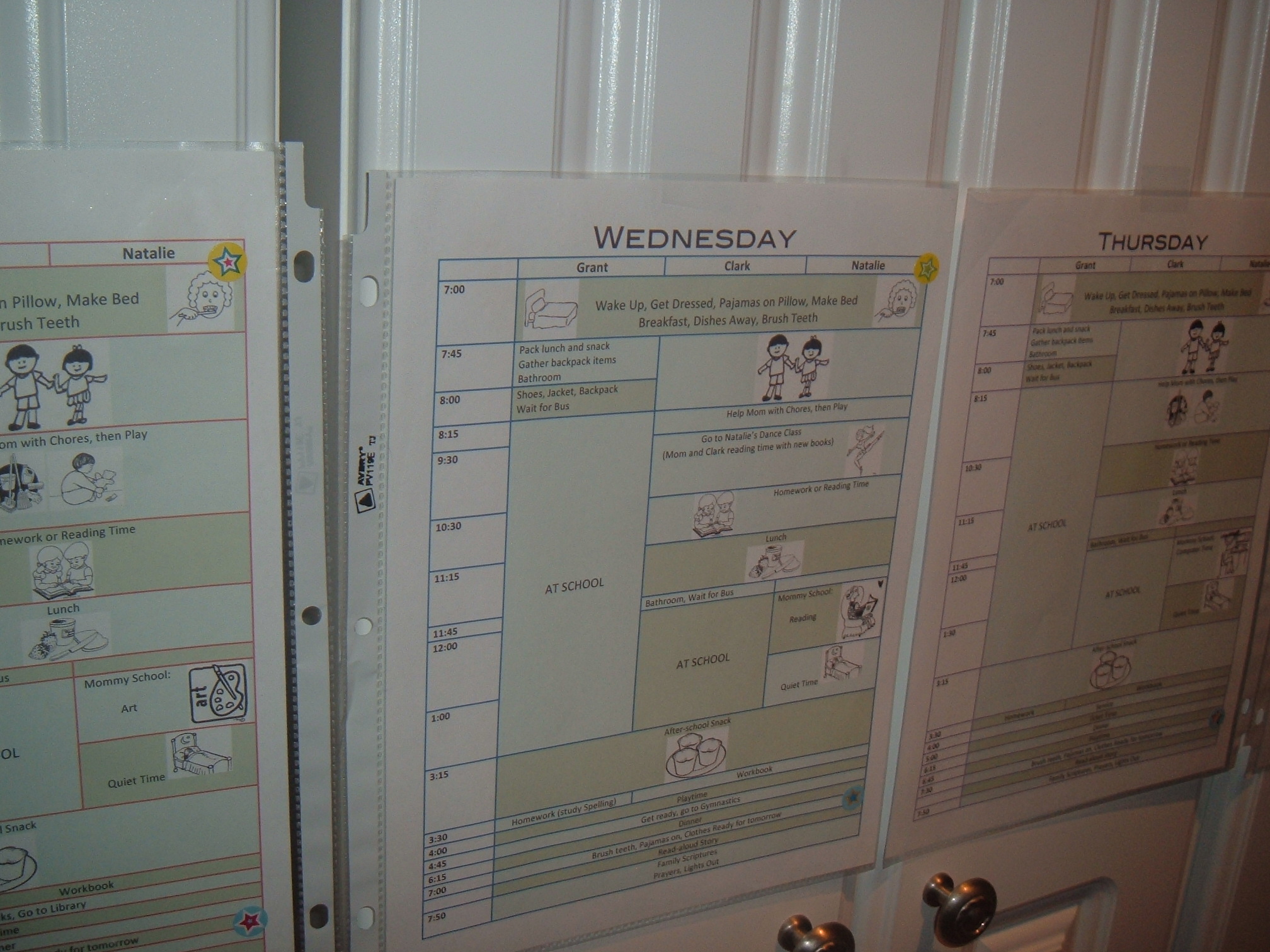
It took days of thought and hours of document design, but this is the final result. (Don’t you dare laugh at me.)
So, this is what I’ve become. I would have never imagined. Then again, I shouldn’t be shocked since I do have a minivan and a mommy blog– a couple other things I probably didn’t originally have on my young, naive list of future plans. Anyway, I was so proud of my new weekly schedule. I showed it to the kids with optimistic enthusiasm. They’re used to my constant charts and signs, so they were on board.
And then like a dark cloud, the holidays were over and today was back to school, back to real life, and test-drive day for our new weekly schedule. Please tell me that your children go through post-holiday detox too. They were out of control. No more presents to open, no more grandparents to entertain them, no more unlimited access to movies and computer games, no more days off of school. If I could describe the day in one phrase . . . it was a day of time-outs within time-outs (breaking rules upon rules while still being punished for the last broken rules). I really wanted to throw out the schedule and tell them to go watch TV until bedtime. Needless to say, my twinkly dreams of an organized and peaceful New Year went up in flames by about 3:00 p.m. and my children’s chances of living through the month were almost completely diminished by 6:00 p.m.
And this is where the whole “resolute” thing comes into play. Are the goals important to me? Yes. Is it worth sticking it out and being consistent? I think so. Will my children be incarcerated in the process? I hope not. I have to believe that with commitment and consistency, we’ll fall into a routine that reflects what kind of family we want to be. This is not a new concept around here– there was a summer schedule and a Fall schedule and this one is just adjusted for changing family needs. (As a side note, I’m not a nazi about the schedule minute-to-minute, but it gives direction and focus to each day. For example, a day with emphasis on service, one on outings, one on chores, etc.) They’ve learned to thrive in the routines in the past and they’ll do it again, if I can survive the first two weeks. Wish me luck.
Here are three talks (in addition to the Sister Beck one I mentioned earlier) that have really helped me in trying to figure out what kinds of things need to be part of our family’s patterns. The first two are both by Elder Dallin H. Oaks, and the third by Elder Bednar.
As the new year approaches, my wheels have been turning. I feel a natural pull to “organize every needful thing,” and set responsible goals. I’m not talking about exercise and diet and cleaning out my closets (though they admittedly maybe should be high on my list), but to see if the way I live my life matches up with the things I really believe are most important.
I chose for this week a talk by Elder Quentin L. Cook of the Quorum of the Twelve because it helps remind me where my greatest responsibilities (a.k.a. “stewardships”) lie. I’m hoping that as I study it this week, it will help me to focus on what matters most as I set my goals and try to create places for righteous patterns in my life. The talk is called “Stewardship — A Sacred Trust.,” and was delivered during the Sunday Afternoon session of conference.
“We try to do what is right because we love and want to please our Father in Heaven, not because someone is forcing us to obey.”
“I would suggest that if we think about giving an accounting of our actions to the Savior, our rationalizations will be seen in their true light.”
“My hope is that each of us will review individually and as families the stewardships for which we have responsibility and accountability.”
You can read it here, or watch it here, or listen here. It’s also on page 91 in the November 2009 Ensign. (Go here if you’re new to the General Conference Book Club and would like to learn more about it.)
I’d love to hear your thoughts about how this instruction can help us shape our goals.
Give me a break. Summer’s busy. I know I’ve been promising this post since May, and I’m just proud I’m finally actually getting around to it. Trust me, a finished project is a victory no matter the delay.
I attended Women’s Conference at Brigham Young University in May, and while I learned many things that were great and uplifting, the highlight for me was the talk given by Sister Julie Beck, General Relief Society President of the Church of Jesus Christ of Latter-day Saints. I know my personal opinion has no bearing on the efficacy of her teachings, but I really like Sister Beck. She is spunky, kind, and speaks truth without fear. Plus (with all due respect) she is the first General Relief Society President in generations that has dared to not have this haircut:
Isn’t she lovely?
Anyway, when I heard her talk, and it affected me the way that it did, I thought to myself, “This is why I came.” She did not say anything that I have not heard taught before, but the cohesiveness and clarity of her message brought me a deeper insight in the doctrine of the family, and a greater understanding of my practical role in it. Loved her talk. (Here is a link to watch her whole talk, entitled “Nourishing and Protecting Home and Family.” It is worth watching.)
From, my notes, here are some highlights:
There are three things that she has felt strongly that women need to do to fulfill their divine role:
Increase faith and personal righteousness.
Strengthen family and homes.
Seek out and help those with needs.
She focused her talk on the doctrine of the family: The Doctrine of family is defined in the Proclamation on the family.
The Plan of Salvation includes the theology of family, as seen in the 3 pillars of the gospel of Jesus Christ:
The Creation– families were formed under God’s direction
The Fall– provided means for family to grow and develop faith
The Atonement– opportunity for eternal growth and restoration.
Marriage is ordained of God, an order of the Priesthood, and necessary to see the face of God and live.
The natures of male and female spirits complete each other.
Both are needed to bring and raise children.
Some scriptural examples of the doctrine of the family and threats to it:
Doctrine and Covenants 2: This is the 1st revelation (chronologically) included in the Doctrine and Covenants; it points to the temple.
Ephesians 6:12 We wrestle against spiritual wickedness (“For we wrestle not against flesh and blood, but against principalities, against powers, against the rulers of the darkness of this world, against spiritual wickedness in high places.”)
Alma, chapter 1: Nehor started the doctrine about “me”– this philosophy is a threat to the family that is about “us/we.”
Alma, chapter 30: Korihor, the “anti-Christ” repeated many of these same philosophies. He was not original or clever; these doctrines were pirated from Satan and other failed leaders.
Anti-Christ principles are always anti-family, and, likewise, anti-family principles are always anti-Christ.
She quoted Spencer W. Kimball, who boldly declared the doctrine as it pertained to traditional family vs. non-traditional families (talk worth reading):
“… Many of the social restraints which in the past have helped to reinforce and to shore up the family are dissolving and disappearing. The time will come when only those who believe deeply and actively in the family will be able to preserve their families in the midst of the gathering evil around us.”
We must preserve our families against gathering evil. We must focus on and prepare our families for blessings of eternal life.
We have to be intentional about everything we do. (This is the part that stood out to me so much, and I felt a strong pull to pay attention to this and apply it in my own life.)
She told a story about her father and her mother sitting down during their honeymoon and setting goals for their family and for their children. What did they want them to accomplish? They made intentional steps to work toward temples, missions, education, work, etc., and then they used those goals to develop the culture of their family. They created a “Personalized Family Plan.”
She reminded us that the commandment to bear children is still a commandment, and that we are still in the “business of creation.”
She touched upon the plague of pornography and stated that she has pondered much about this problem and tried to understand what the role of the women of the Church is in this challenge, and said that her clear impression has been: “Fight! Fight pornography and defend our homes.” I wish I convey the spirit in which she made that challenge and how moving it was. It actually brought much of the audience to spontaneous applause.
The following were some of her concluding suggestions and reminders to consider as we become intentional parents in gospel-based homes:
Limit activities, and use time to teach. Talk, teach, ask questions.
Family Home Evening is so important– interruptions should be avoided. We must prepare our families for the challenges to come.
Sacrifice your life (mom) for their good.
You can’t drive them or force them. Only correct in kindness and love, and persuasion. Make homes based on love.
Husbands need to be loved also. (D&C 25) Be a comfort, show meekness, create a climate of charity, faith and hope.
Seek for and qualify for the voice of the Spirit everyday. This (motherhood) is a faith-based work. We must call upon our faith– faith in who we are, where we came from, and what we’re called to do.
In Moses 5:10-13, Adam and Eve review the blessings of mortality:
10 And in that day Adam blessed God and was filled, and began to prophesy concerning all the families of the earth, saying: Blessed be the name of God, for because of my transgression my eyes are opened, and in this life I shall have joy, and again in the flesh I shall see God.
11 And Eve, his wife, heard all these things and was glad, saying: Were it not for our transgression we never should have had seed, and never should have known good and evil, and the joy of our redemption, and the eternal life which God giveth unto all the obedient.
12 And Adam and Eve blessed the name of God, and they made all things known unto their sons and their daughters.
What else can I say? I felt so inspired by this talk, like it was a call to battle. It made me want to rise up and do better, be better. I know that our roles as mothers is so important, and our power and influence will be needed more and more as the world tries to destroy the faith we hold dear.
This video is from a different, previous talk by Sister Beck entitled “Mothers Who Know,” with clips set to pictures and music. It further solidifies the divine role of mothers. Hope you find its message as inspirational as I did. (It describes an ideal mother. None of us are ideal, but it sets a standard to strive for, not a measuring stick for guilt.)
For any of my readers unfamiliar with the Mormon faith, we believe in a living prophet and twelve apostles. Every 6 months, the membership of the church worldwide participates in General Conference, usually watching on TV by satellite as these prophets, seers and revelators teach us about the doctrine of Christ. It’s kind of a modern-day Sermon on the Mount. Anyway, it’s one of my favorite times of the year; a time of spiritual refueling and a re-commitment to things that I know are true and right.
I like to think that I’ve matured spiritually a little bit over the years. I personally believe that one of the signs of spiritual maturity is to listen to talks and lessons and seek for ways to apply the principles to my own life instead of thinking things like, “I hope so-and-so is paying attention to this,” or “The such-and-such family should really hear this talk.” I’ve finally determined that passing off a teaching to another is a wasted opportunity to better myself. Having said that, I can totally understand Matt’s excitement to run home from the Priesthood session of Conference on Saturday night and say to me, “You’ll never guess what President Uctdorf said. You’re going to die!” I raised an eyebrow while he flipped through his notes. “He said Don’t spend hours and hours creating a blog and neglecting your children.”
So I have decided to leave the church.
Just kidding.
This leads me to the concept of conference-induced guilt. And like the title of my post says, it’s a good thing. What I feel is not a Boy-you’re-making-a-lot-of-mistakes-and-you-are-a-failure feeling, but rather a humbling You-are-trying-but-you-can-do-better feeling. And it’s good for me. It motivates me, reminds me, encourages me. It re-converts me.
So here is a list of things that I learned from General Conference this weekend. Some are things that were specifically said. Many are thoughts that came into my mind and heart as I listened.
I’m thankful that there are living prophets on the earth.
My children have been driving me crazy this past week, but I love them. I need to make them a priority. And besides teaching them, I need to pray for them and ask God to bless them to grow up righteous and obedient.
I need to laugh more instead of getting bugged.
The temple is important. As the world gets crazier, the need for the peace of the temple will grow and grow. Maybe I can eliminate something from my budget so that I can pay a regular babysitter and put temple attendance as a regular item on my calendar.
I don’t even know what real adversity is. My life, though sometimes emotionally challenging is a piece of cake compared to some of the great challenges other people have faced. Instead of complaining about my bad days, I should be grateful for my abundant blessings and ease.
I need to be more worried about what God thinks than what anyone else thinks.
The depth of Jesus Christ’s Atonement is awesome. I am reminded that my small, occasional feelings of loneliness can be swallowed up and comforted by a loving, completely understanding Savior. (Elder Holland’s was my very favorite talk.)
Satan is working hard to destroy things that are important. When I get in a grumpy funk, I’m not the best companion in the world. I need to be careful that I don’t let that kind of temptation/distraction be a detriment to my marriage. I’m sure Satan would love to see it fail.
I can give a little more to my calling at church. My Sundays should be spent in service to others. Ask myself, “How can I bless people today?” Perhaps I need to visit more of the children to show love to them. I need to teach reverence and respect to the Primary children, starting with my own example.
When someone is lost or stranded spiritually, we should reach out to them and not judge.
I’m sure that when I re-read the talks in the Ensign magazine, many other things will stand out to me and I will again desire to do better. Is anyone interested in having an online Ensign Book Club? We could schedule one talk a week to study from the most recent conference, and then have an in-post discussion about our favorite parts and insights– lessons we learn, things to work on, etc. I’m not sure about all the details, but I would love to have a forum where we could study something together and report to each other about our insight. Just a thought.





 Diapers and Divinity